"Olo": The New Color Discovered by Stimulating the Eye With Lasers
A team of scientists has discovered a color that no human has ever seen before. Called "olo," it is a saturated blue-green that cannot appear in natural vision. The researchers created it by firing precision laser pulses into the eye to stimulate individual cone cells in isolation, something the human visual system was not designed to do.
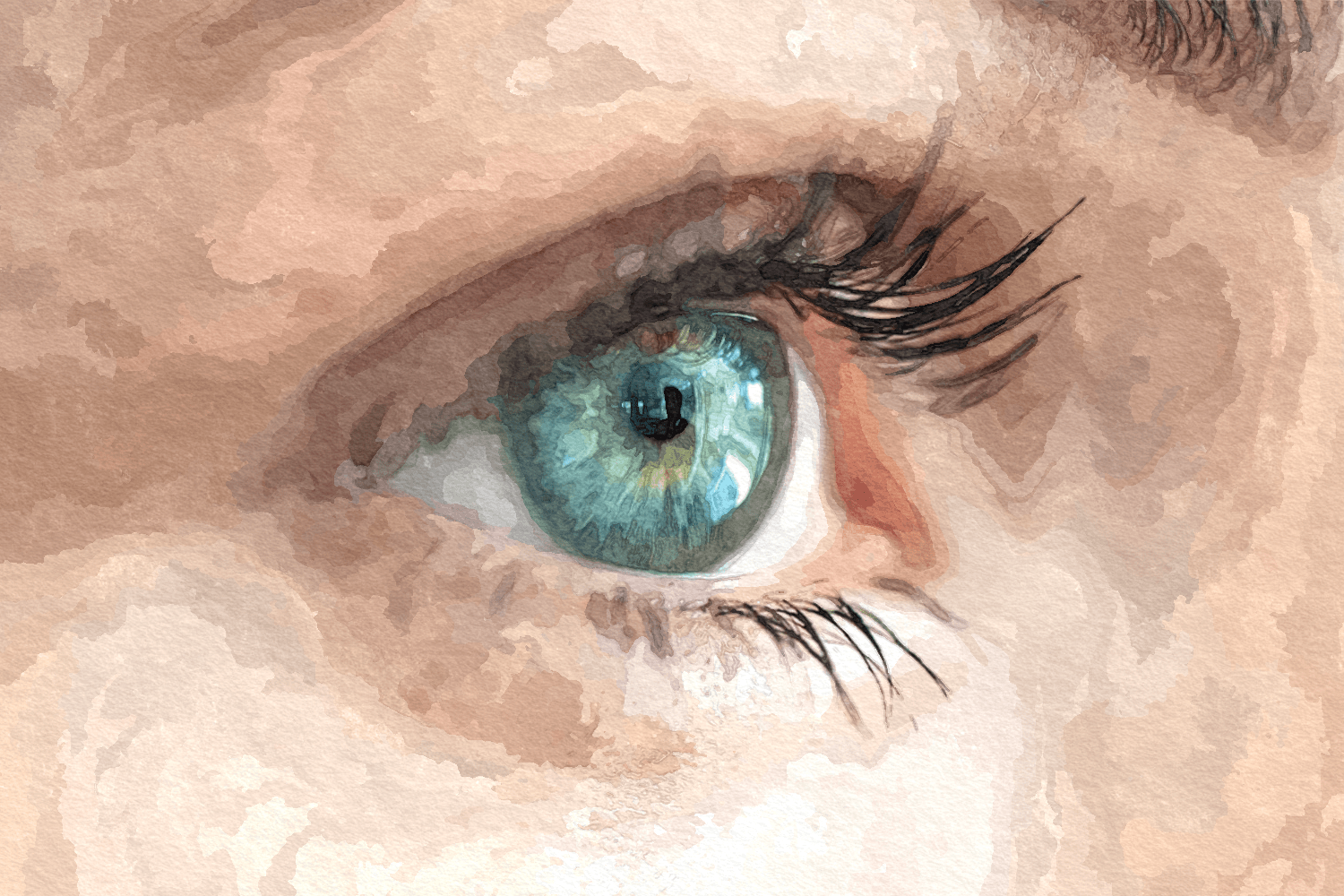
In April 2025, a team of researchers from the University of California, Berkeley, and the University of Washington published a paper in Science Advances with a striking claim: they had discovered a color that no human being had ever seen before. The color, which they call olo, is a saturated blue-green that cannot be produced by any combination of light in the natural world. It exists only when the eye is stimulated in a way that evolution never intended.
The findings are the result of years of work on a device called Oz, an optical system of mirrors, lasers, and precision optics that can target individual types of cone cells in the human retina. By firing laser pulses that selectively activate only one kind of cone cell without triggering its neighbors, the researchers generated a color signal that the brain has no evolutionary framework for processing, producing a percept that no natural scene can create.
The discovery has been met with excitement, healthy skepticism, and a deeper question: what does it mean to discover a new color?
How Human Color Vision Normally Works
To understand why olo is remarkable, you have to understand the biology of color perception. The human retina contains three types of cone cells, each sensitive to a different range of wavelengths. S cones respond to short wavelengths (blue), M cones to medium wavelengths (green), and L cones to long wavelengths (red). Every color you have ever seen is the result of some combination of these three signals.
The critical detail is that in natural vision, these cells never fire in isolation. Any light source that stimulates M cones will also partially stimulate L and S cones, because the sensitivity curves overlap. A green leaf reflects light that triggers M cones strongly and L cones weakly. A blue sky triggers S cones strongly and M cones weakly. The output is always a blend. The brain evolved to interpret the relative ratios of activation across the three cell types, and this ratio-based system defines the entire gamut of human color perception.
Until now, it was assumed that isolating a single cone type was impossible. The optical properties of the eye scatter light across the retina, and individual cones are packed tightly together at a density of around 200,000 per square millimeter at the fovea. Targeting one without hitting its neighbors seemed beyond the reach of any optical system.
The Experiment: The Oz Device
The key breakthrough was the Oz device, an optical system designed by the researchers over several years. Oz uses adaptive optics to correct for the eye's natural aberrations, similar to the technology used in astronomical telescopes to compensate for atmospheric distortion. By measuring the precise optical properties of each participant's eye and compensating for them in real time, Oz can focus a laser beam to a spot smaller than a single cone cell.
The laser was tuned to a wavelength of around 540 nm, which falls in the green region of the spectrum where M cone sensitivity peaks but L and S cone sensitivity is minimal. By scanning the beam across the retina and monitoring the participant's responses, the researchers identified locations where the laser activated M cones alone. When the beam landed on a patch of retina containing only M cones and the participant reported seeing a color, that color was olo.
Five participants with normal color vision took part in the study, three of whom were co-authors of the paper. Each participant sat with their head stabilized while the Oz device fired laser pulses into one pupil. After each pulse, participants adjusted a color dial to match what they had seen, providing a quantitative measure of the perceived hue, saturation, and brightness.
What Olo Actually Looks Like
Participants consistently described olo as a highly saturated blue-green, more intense than any cyan or turquoise they had seen before. The researchers produced an approximation shown in the journal article, but they caution that no screen can reproduce the actual percept. The color is fundamentally outside the gamut of any display because displays work by mixing red, green, and blue primaries, which always activate multiple cone types simultaneously.
The name olo was chosen to be neutral. It is short, unfamiliar, and carries no linguistic associations with existing colors. The researchers wanted a label that would not bias participants toward describing the color in terms of known categories like cyan or teal, because olo is genuinely different from any color in those categories. It is more saturated, more intense, and perceptually distinct from anything the natural world can produce.
The Skepticism: Is It Really a New Color?
Not everyone is convinced. Prof John Barbur, a vision scientist at City St George's, University of London who was not involved in the study, described the experiment as a "technological feat" but argued that calling the result a new color is "open to argument." His reasoning: if you stimulate any cone type strongly enough, you will produce a vivid version of the color associated with that cone. Stimulating L cones in large numbers produces a deep red. Stimulating M cones in isolation produces a vivid green-blue. The percept may be novel to the individual, but it fits within the known framework of color vision.
The study's co-author, Prof Ren Ng from UC Berkeley, acknowledged the debate but pointed to a more fundamental claim: olo is not just vivid, it is qualitatively different from any color produced by natural light. "Let's say you go around your whole life and you see only pink — baby pink, pastel pink — and then one day someone is wearing a shirt that is the most intense pink you have ever seen, and they say it is a new color and we call it red," Ng told the BBC. The analogy captures the core idea: olo may be a color that belongs to a category we already know (blue-green), but it exists at an intensity that category was never capable of reaching.
What This Means for Color Blindness Research
The most promising application of the research is in the treatment of color blindness. Approximately 8% of men and 0.5% of women have some form of color vision deficiency, most commonly difficulty distinguishing between red and green. The underlying cause is typically a missing or altered cone type: people with red-green color blindness lack either functional L or M cones.
The Oz device demonstrates that it is possible to artificially generate color signals in the retina by targeting specific cells. If this technology can be miniaturized and made safe for regular use, it could potentially bypass defective cone cells and stimulate the remaining cells to produce color percepts that the eye cannot generate on its own. A person with missing M cones might be able to perceive green signals through targeted stimulation of neighboring cells.
This is still speculative. The current setup uses a tabletop optical system that requires the participant to sit perfectly still while lasers are aimed at their retina. Making this practical for clinical or everyday use would require advances in head-mounted adaptive optics, real-time retinal tracking, and safety validation for extended use. But the foundational principle, that individual cone types can be addressed independently, is now experimentally established.
The Bigger Picture
The discovery of olo touches on a deeper philosophical question about the nature of color. Color is not a physical property of light. It is a perceptual construct created by the brain from the signals sent by three types of cone cells. The entire visible world fits inside the triangle defined by those three primaries. But the triangle has edges that we never see, regions of color space that correspond to activating one cone type alone. Olo lives on that edge.
The research suggests that there is unexplored territory in human perception, even in something as fundamental as color. The brain evolved to interpret ratios, not absolutes, and the parts of color space that require absolute rather than relative signals have been invisible to us for our entire evolutionary history. Olo is the first glimpse of that invisible territory.
Whether you call it a new color or a novel combination of existing ones, the experience of olo is something no human had ever had before the Oz device was built. That alone makes it worth paying attention to.