NASA's Next Great Observatory Is Sitting in a Clean Room in Florida. In Six Weeks, Everything Changes.
On August 30, the Nancy Grace Roman Space Telescope will launch from Kennedy Space Center on a Falcon Heavy. It carries a mirror the same size as Hubble's, a camera a hundred times wider, and a coronagraph that can see planets a hundred million times fainter than their stars. Roman will map a billion galaxies, find a hundred thousand exoplanets, and take the clearest measurement yet of whatever is tearing the universe apart.
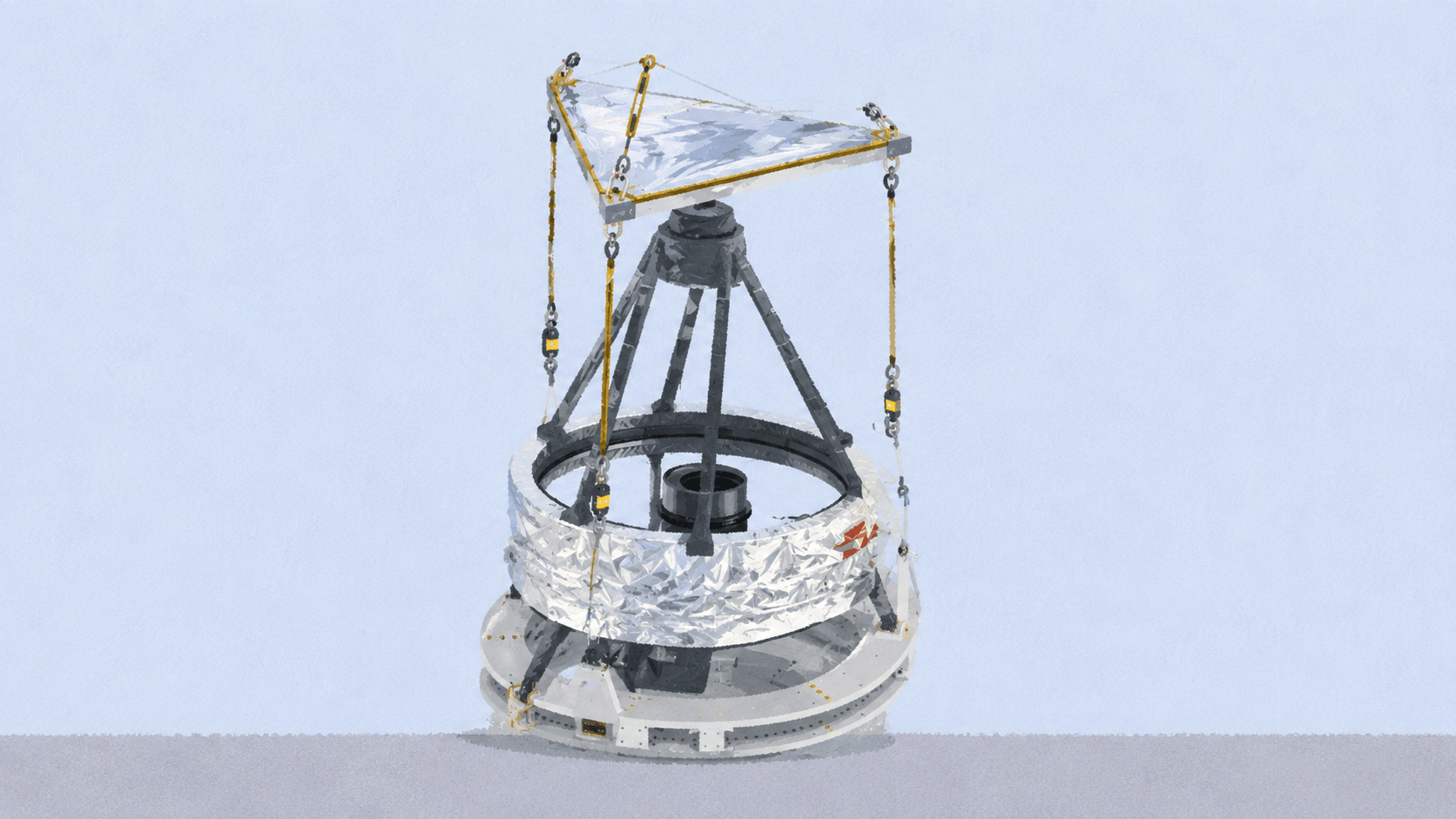
On August 30, 2026, assuming Florida weather cooperates, a SpaceX Falcon Heavy will lift off from Launch Complex 39A carrying NASA's next flagship observatory. The Nancy Grace Roman Space Telescope has been in development for over a decade, survived a naming controversy, a rebranding from WFIRST, and the kind of budget uncertainty that defines large NASA projects. But now it is real. The telescope arrived at Kennedy Space Center on June 21. Engineers are fueling it with 290 gallons of hydrazine as you read this. The launch window opens in six weeks.
The specs are remarkable in a way that takes a moment to appreciate. Roman's primary mirror is 2.4 meters across, the exact same diameter as Hubble's. But that is where the similarity ends. Roman's Wide Field Instrument is a 300-megapixel camera with 18 detectors, each capturing a 4096×4096 image. Together they cover 0.28 square degrees of sky per exposure. That is roughly 100 times wider than Hubble's Advanced Camera for Surveys and about 50 times wider than Webb's NIRCam. A single Roman image captures an area of sky larger than the apparent size of the full Moon.
Roman can survey the sky up to 1,000 times faster than Hubble. Over its five-year primary mission, it will image over 50 times as much sky as Hubble covered in 30 years.
The Wide vs. Deep Problem
To understand why Roman matters, you have to understand the fundamental trade-off that every space telescope makes: wide versus deep.
Hubble was designed for detail. Its 2.4-meter mirror and ultraviolet-to-infrared instruments produce the sharpest visible-light images ever taken from space, but each exposure covers a tiny patch of sky, about 0.003 square degrees with its Advanced Camera for Surveys. Hubble is a telephoto lens aimed at the cosmos. Webb is even more extreme. Its 6.5-meter mirror collects roughly 7 times more light than Hubble's, letting it see galaxies that formed just 300 million years after the Big Bang. But Webb's field of view is similarly narrow. It is a microscope for the early universe.
Roman flips the model. It uses the same 2.4-meter mirror as Hubble, but it distributes that light across a much wider area. The trade-off is that Roman cannot see quite as deep as Hubble or Webb. It will reach back about 10 billion light-years rather than 13.6 billion, but it can see vastly more objects in the same amount of time.
This is not a compromise. It is a deliberate design choice driven by the questions Roman is built to answer. Dark energy, dark matter, and exoplanet demographics are statistical sciences. They require enormous samples: hundreds of millions of galaxies, a hundred thousand planets, a billion stars. You cannot answer these questions by staring at one object for a week. You need a wide-angle lens.
The Coronagraph and Starglasses
Roman carries a second instrument that has never been flown in space before: an active coronagraph.
A coronagraph blocks light from a bright star so you can see the dim planets orbiting it. Every space telescope with a coronagraph, like Hubble and Webb, uses passive technology: fixed masks that block starlight at specific positions. Roman's Coronagraph Instrument works differently. It contains deformable mirrors with thousands of tiny actuators that move like pistons, changing the mirror shape in real time to cancel out starlight. NASA calls them “starglasses.”
This active wavefront control is the breakthrough. Previous space coronagraphs can suppress starlight by a factor of about a million to one. Roman's coronagraph aims for a billion to one, a thousand times better. That is the difference between seeing only hot young Jupiter-mass planets and seeing older, colder Jupiter-analogs that reflect rather than emit their light. The instrument can detect planets 100 million times fainter than their host stars.
The Coronagraph Instrument is a technology demonstration. It will operate for a limited portion of Roman's mission. But if it works, it proves the active coronagraph architecture for the next generation of space telescopes, the ones designed to find Earth-like planets around Sun-like stars. LUVOIR, HabEx, whatever comes next, they all need active coronagraphs. Roman is the test flight.
The Dark Universe
Roman's primary science case is dark energy, the mysterious force that appears to be accelerating the universe's expansion. The evidence for dark energy comes from observations of distant supernovae, but the underlying physics is unknown. It could be a cosmological constant, a scalar field, or a sign that general relativity breaks down at cosmic scales. Roman is built to find out.
Its High-Latitude Wide-Area Survey will cover over 2,000 square degrees of sky, about 5 percent of the entire sky, combining imaging and spectroscopy. Roman will measure the shapes and distances of over a billion galaxies. By analyzing how their light is distorted by the gravity of intervening matter through weak gravitational lensing, astronomers will create a 3D map of dark matter distribution across cosmic time. Then they will compare that map to what the universe should look like under different dark energy models.
The precision target is ambitious. Roman will measure dark energy's effects 10 times more precisely than current observations. Recent results from Webb and other telescopes have hinted that dark energy may have been stronger in the early universe and weaker today. Physicists call this “evolving dark energy.” Roman is the telescope that can confirm or refute that signal.
The same survey will also gather spectra from about 20 million galaxies, measuring their redshifts to create a three-dimensional map stretching back 11.5 billion years. The pattern of galaxy clustering in that map, specifically, the scale of baryon acoustic oscillations, the frozen-in ripples from the early universe, functions as a standard ruler. Roman will measure how that ruler has stretched over cosmic time, revealing how dark energy has shaped the expansion history of the universe.
The Exoplanet Census
Roman's Galactic Bulge Time-Domain Survey will monitor over 100 million stars toward the center of the Milky Way. It will find planets using two methods simultaneously.
The first is transits. As planets cross in front of their host stars, Roman's 15-minute cadence imaging in the F146 filter will detect the resulting dip in brightness. Current predictions estimate Roman will find between 60,000 and 200,000 transiting planets, an order of magnitude more than the total number of known exoplanets today. Most will be giant planets on close-in orbits, but the yield includes an estimated 7,000 to 12,000 small planets under four Earth radii.
The second method is gravitational microlensing. When a star passes in front of another star from our line of sight, its gravity bends and magnifies the background star's light. If the foreground star has planets, they create detectable distortions in the magnification. Microlensing is uniquely sensitive to planets in wide orbits, analogs to our own solar system's Jupiter and Saturn, and to free-floating planets not bound to any star. Roman is expected to find over 1,000 microlensing planets, including some as small as Mars.
Combined, these two surveys will give astronomers the first statistical census of planetary systems across the entire Milky Way. Kepler showed that planets are common around stars in our corner of the galaxy. Roman will answer whether that holds true near the galactic center, where stellar density is a thousand times higher and the radiation environment is far more hostile.
The Data Flood
Roman will generate approximately 1.4 terabytes of data per day, 11 terabits per day. Over five years, that adds up to about 20 petabytes. For context, that is roughly 20 times the total data volume produced by all previous NASA astrophysics missions combined.
The downlink infrastructure is itself a feat. Roman communicates through ground stations in New Mexico, Australia, and Japan, transmitting at 250 to 500 megabits per second. The data are processed at the Space Telescope Science Institute in Baltimore and IPAC in Pasadena, then released to the public immediately with no proprietary period. Every Roman image will be available to any astronomer, anywhere in the world, as soon as it is calibrated.
This open-data philosophy is a direct legacy of Nancy Grace Roman herself. She championed the idea that space telescope data should belong to the entire scientific community, not just the teams that built the instruments. Hubble eventually adopted the same model. Roman was designed around it from the start.
The Sprint to the Pad
As of July 16, 2026, Roman is inside the Payload Hazardous Servicing Facility at Kennedy Space Center. It arrived on June 21 after a voyage from Goddard Space Flight Center aboard the Pegasus barge, the same barge that once ferried Space Shuttle external tanks. Engineers have already completed initial checkouts and powered tests. Next comes the loading of approximately 290 gallons of hydrazine fuel, followed by encapsulation inside the Falcon Heavy payload fairing. Then the integrated stack rolls out to Launch Complex 39A.
The launch date of August 30 represents a significant acceleration. Roman was originally scheduled for 2027. NASA moved it up after the telescope passed its final major prelaunch tests in March, acoustic and vibration testing that blasted the observatory with extreme sound and shook it to simulate launch conditions. Roman passed all three assessments.
After launch, Roman will coast to the Sun-Earth L2 Lagrange point, approximately one million miles from Earth, the same orbit occupied by Webb and ESA's Euclid. The commissioning timeline is compressed: solar panels and sunshade deploy within five hours, the high-gain antenna within two days, the Coronagraph Instrument activates at one week, the Wide Field Instrument powers on at three weeks. Science operations begin three months after launch, with the first public images expected shortly after.
The Webb Synergy
Roman and Webb will orbit the same point in space, operate at the same time, and study overlapping wavelengths. They are designed to work as a pair.
The model is pipeline science. Roman's wide surveys will identify rare or interesting objects at scale: unusual galaxy morphologies, high-redshift quasars, microlensing planet candidates, supernovae within hours of detonation. Webb can then follow up with deep spectroscopy and mid-infrared imaging that Roman cannot do. Roman discovers; Webb characterizes. The Space Telescope Science Institute, which operates both missions, is already planning joint observing programs.
This synergy is the core argument for Roman's design. A narrow-field telescope like Webb working alone would miss almost every transient event in the universe because it simply cannot watch enough sky. A wide-field telescope like Roman working alone would lack the sensitivity and wavelength range to study individual objects in detail. Together they cover both extremes.
What We Are Actually Waiting For
The Roman Space Telescope is the kind of mission that does not produce a single iconic image. Its discoveries will be statistical: a measurement of dark energy with uncertainties cut by a factor of ten; a map of dark matter across half the universe; the confirmation or refutation of evolving dark energy; a complete census of planetary architectures in the Milky Way.
But there will also be the unexpected. Roman will observe the galactic bulge at a cadence that catches supernovae within hours, tidal disruption events as black holes shred passing stars, and microlensing events that reveal otherwise invisible populations of black holes and neutron stars. Its wide-area survey will uncover faint dwarf galaxies in the Local Group that even Webb cannot find by itself. The Coronagraph Instrument may return the first direct image of a Jupiter-like planet around a Sun-like star, something no existing telescope has ever done.
Roman is named after the woman who made Hubble possible. It carries a mirror the same size as Hubble's but points it at 100 times more sky. It will generate data faster than any space telescope before it and give that data away for free. It is launching in six weeks on a rocket named Falcon Heavy, from the same pad that sent humans to the Moon.
The engineering is done. The telescope is on the ground in Florida, being fueled and buttoned up. What comes next is science.