Microsoft's Majorana Particle: Topological Qubits and What They Actually Mean
In 2025, Microsoft published evidence of a topological qubit built from Majorana zero modes in a Nature paper that the quantum computing world is still digesting. Here is what a Majorana particle actually is, how Microsoft’s qubit works, and why topological protection changes the math on fault-tolerant quantum computing.
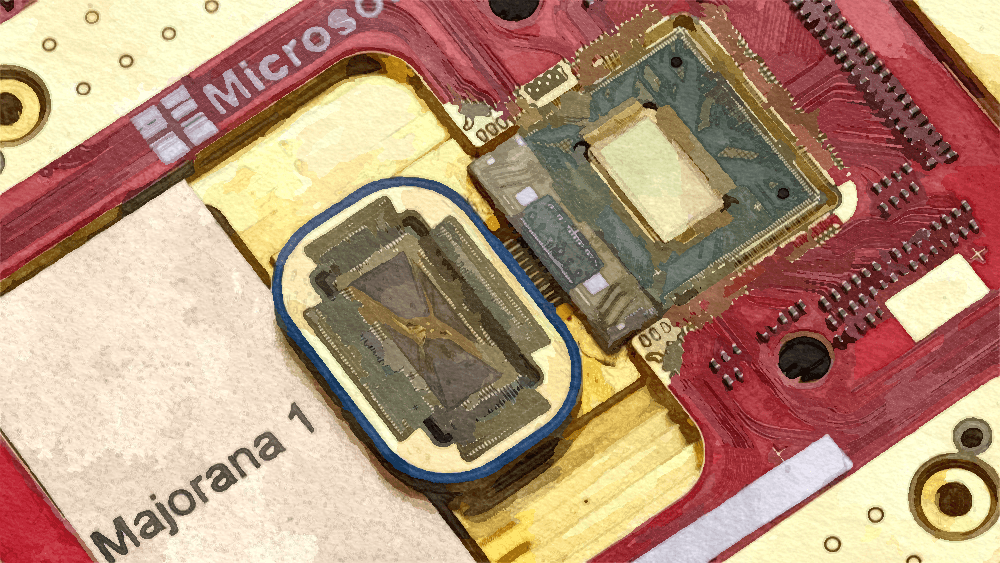
On the list of things most people have heard of but cannot explain, the Majorana particle sits somewhere near the top. It is a particle that is its own antiparticle. It is the foundation of Microsoft’s entire quantum computing strategy. And it may be the key to building a quantum computer that does not need millions of physical qubits to correct errors it should not have in the first place.
In 2025, Microsoft published a paper in Nature demonstrating a topological qubit based on the Majorana zero mode, a quasiparticle that emerges at the boundaries of specially engineered nanowires. This followed a 2023 paper in Physical Review B that provided the first convincing evidence of the topological gap. And it came four years after a high-profile retraction of a 2018 Nature paper that forced the field to slow down and reconsider its methods.
The 2025 results look real. Here is what they actually mean.
What Is a Majorana Particle?
The story starts in 1937, when the Italian physicist Ettore Majorana published a paper that modified the Dirac equation to allow a particle that is its own antiparticle. Dirac had shown in 1928 that the electron must have an antiparticle (the positron, discovered in 1932). Majorana asked: what if a particle existed where the wavefunction of the particle and its antiparticle are the same?
For sixty years, this was a purely theoretical curiosity. The neutrino was proposed as a candidate, but we still do not know whether neutrinos are Majorana particles. The real breakthrough came in condensed matter physics, when theorists realized that Majorana particles could emerge as quasiparticles in certain materials, not as fundamental particles but as collective excitations that behave like them.
In 2010, a team including Microsoft’s Station Q proposed that Majorana zero modes could be created in semiconductor nanowires coupled to superconductors. The key idea: when a semiconductor with strong spin-orbit coupling is placed next to a superconductor and exposed to a magnetic field, the system transitions into a topological phase where Majorana zero modes appear at the wire ends. These modes are pinned to zero energy and are topologically protected: local perturbations cannot destroy them without crossing an energy gap.
The Topological Qubit
A standard qubit encodes information in a two-level quantum system. A superconducting qubit uses the quantized energy levels of a Josephson junction. A trapped ion qubit uses the electronic states of an ion. These are all local degrees of freedom, which means they couple to the environment and lose coherence on timescales of microseconds to milliseconds. Error correction is possible but expensive: Google’s Willow chip uses 105 qubits, but a fault-tolerant logical qubit likely requires 1,000 or more physical qubits with current surface codes.
A topological qubit works differently. Instead of storing information in a local degree of freedom, it stores information in the global state of a system. Specifically, Microsoft’s qubit encodes information in the parity (even or odd) of the number of electrons across two Majorana zero modes. This parity is a non-local property: it depends on the state of two quasiparticles at opposite ends of a nanowire, not on the state of any single point in the system.
The consequence is topological protection. To flip the qubit, an environmental perturbation must physically move a quasiparticle from one end of the wire to the other, passing through the topological gap. This is not just difficult; it is exponentially suppressed at low temperatures. The qubit is protected by the same mathematics that protects the quantum Hall effect: the state is encoded in global topology, and local noise cannot touch it.
How Microsoft Builds These Qubits
The fabrication process is a marvel of materials engineering. Microsoft uses an indium arsenide (InAs) semiconductor nanowire grown epitaxially on a substrate. The wire is partially coated with aluminum, which becomes superconducting at cryogenic temperatures (below 1.2 K). The interface between the InAs and Al creates a hard superconducting gap, a region where no single-particle states exist, only Cooper pairs.
A magnetic field of approximately 100 mT is applied along the wire axis. Combined with the strong spin-orbit coupling in InAs, this drives the system into the topological phase. At the boundary between the Al-coated (superconducting) and bare (normal) sections of the wire, a Majorana zero mode emerges, pinned to exactly zero energy within the superconducting gap.
Reading out the qubit state requires measuring the parity of the two Majorana modes. Microsoft does this using a quantum dot coupled to one end of the nanowire. By tuning the dot through a charge transition and measuring the tunneling current, they infer whether the combined system has even or odd parity. The 2025 Nature paper demonstrated that this parity readout can distinguish topological states with high fidelity and that the topological gap is approximately 20 μeV, large enough to suppress thermal excitations at the 20 mK operating temperature.
The Industry Context
Microsoft’s approach is the long bet in quantum computing. Google and IBM use superconducting transmon qubits, which exist today but require aggressive error correction. Quantinuum and IonQ use trapped ions, which have the highest gate fidelities but are harder to scale. PsiQuantum is betting on photonics. Each approach has trade-offs between gate speed, coherence time, and scalability.
Topological qubits, if they work at scale, win on coherence. A topologically protected qubit could have coherence times measured in hours or days rather than microseconds, because the protection mechanism is built into the hardware at the physical level, not bolted on through error-correcting codes. The cost is that the qubits are harder to fabricate, harder to operate, and slower to manipulate. Braiding operations, which form the basis of topological quantum gates, require physically moving Majorana modes past each other, an intrinsically slow process.
Microsoft has taken the unusual step of building an entire quantum computing stack, including a topological qubit chip, a dilution refrigerator system, and a cloud interface through Azure Quantum, before having a fully working multi-qubit processor. The bet is that when the topological qubit works, it works so much better than the alternatives that the slow start does not matter.
The Skepticism
The history of Majorana research demands caution. In 2018, Microsoft published a Nature paper claiming evidence of Majorana zero modes. In 2021, the paper was retracted after independent researchers identified issues with the data analysis and background subtraction. The retraction was a serious blow to the field and to Microsoft’s credibility.
The 2023 and 2025 papers addressed these concerns. They used improved measurement techniques, including tunnel spectroscopy with multiple quantum dots and more rigorous background subtraction. The topological gap was measured directly, and the parity readout was shown to be robust across multiple devices. The community has been cautiously receptive, but full acceptance will require independent replication, which is difficult because the devices are extraordinarily hard to fabricate.
There is also the question of scale. Demonstrating a single topological qubit is one thing. Demonstrating a two-qubit gate is another. And building a 1,000-qubit topological processor is something entirely different, requiring advances in nanowire uniformity, gate design, and braiding control that may take a decade or more.
What This Actually Means
Microsoft has shown that topological qubits can be built and measured. The parity readout works, the topological gap is real, and the protection mechanism is consistent with theory. If these results hold, topological qubits could eventually reduce the overhead of quantum error correction by orders of magnitude, making fault-tolerant quantum computing economically viable rather than just theoretically possible.
But eventual is doing a lot of work in that sentence. The engineering challenges between a single qubit in a dilution refrigerator and a fault-tolerant quantum computer are immense. Microsoft is competing with companies that already have 100+ qubit processors, working two-qubit gates, and paying customers. The topological advantage only matters if Microsoft can actually scale the hardware.
For now, the Majorana particle is real, the qubit works, and the physics is beautiful. The engineering is what comes next.